UAE e-invoicing for trading companies starts on 1 January 2027 for businesses with annual revenue of AED 50 million or more, and on 1 July 2027 for everyone else in scope. Before going live, each business must appoint an accredited service provider (ASP): larger businesses had until 30 October 2026, and smaller ones have until 31 March 2027 (WAM; MoF). This guide covers who is in scope, the penalties, and the ERP checklist traders should work through now, because most e-invoicing problems start with messy invoice data, not the technology.
Last checked: 16 November 2026.
What is UAE e-invoicing?
UAE e-invoicing is a national system in which invoices are exchanged as structured data between businesses through accredited service providers, with tax data reported to the authorities. The Ministry of Finance set out the framework in Ministerial Decision No. 243 of 2025 and the timeline in Ministerial Decision No. 244 of 2025, both issued on 29 September 2025 (WAM). The model is a decentralised five-corner network based on Peppol (MoF programme update).
In practice, your ERP creates the invoice, your ASP validates and sends it, the buyer’s ASP delivers it to the buyer’s system, and the data is reported to the Federal Tax Authority. A PDF sent by email will no longer count as the invoice for in-scope transactions once your phase is live.
When does UAE e-invoicing apply to my company?
Your dates depend on annual revenue.
Group | Appoint an ASP by | Mandatory from |
Pilot (selected taxpayers and volunteers) | Not applicable | 1 July 2026 |
Revenue of AED 50 million or more | 30 October 2026 (extended from 31 July 2026) | 1 January 2027 |
Revenue below AED 50 million | 31 March 2027 | 1 July 2027 |
In-scope government entities | 31 March 2027 | 1 October 2027 |
Sources: WAM, 29 September 2025; MoF programme update, 30 June 2026.
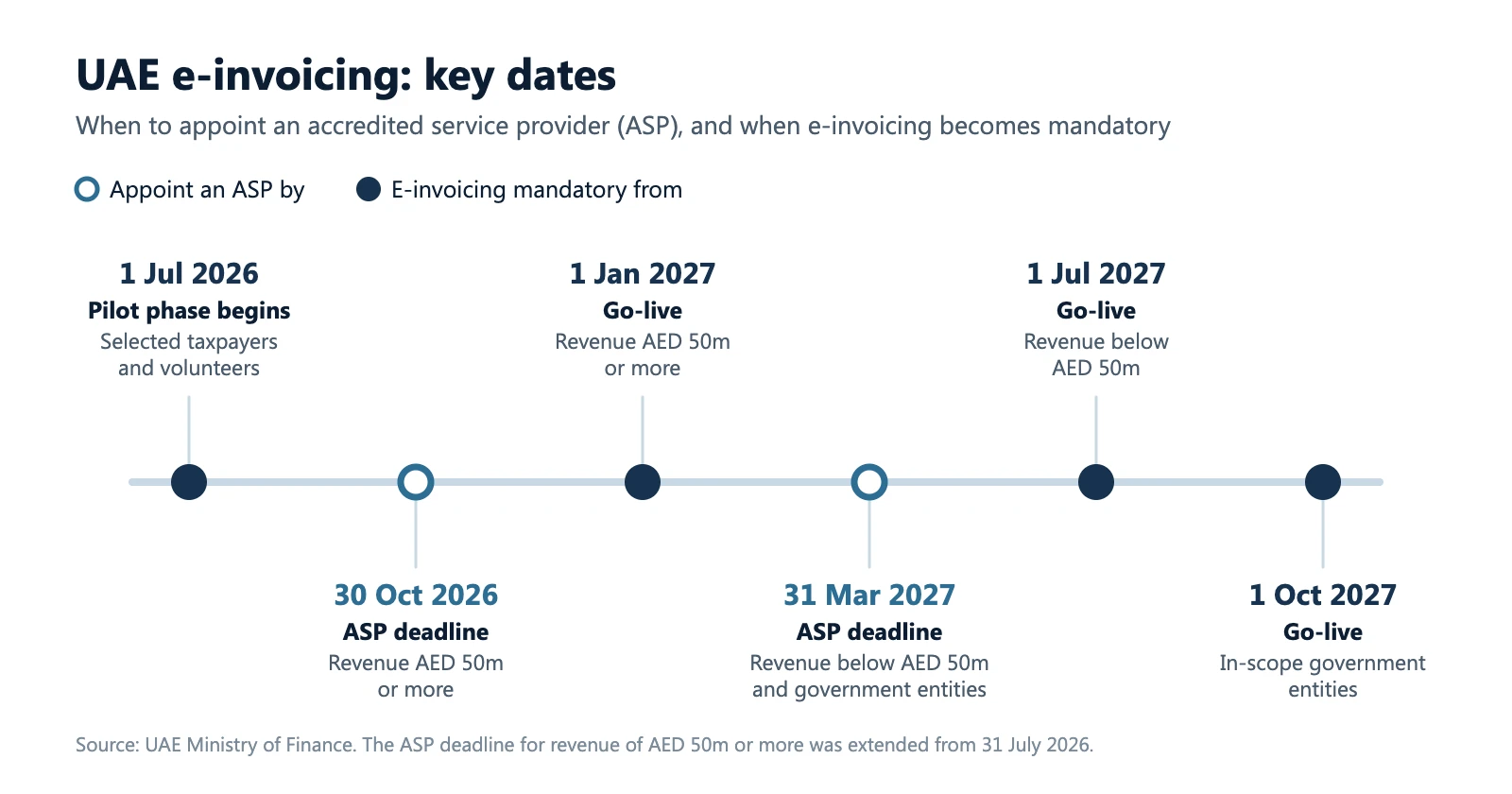
If your revenue is AED 50 million or more and you have not yet appointed an ASP, speak to your tax adviser now about the penalty position below.
Does UAE e-invoicing apply to free zone and DMCC traders?
The Ministry’s guidelines apply the system to persons doing business in the UAE regardless of VAT registration status, unless specifically excluded under Article 4 of Ministerial Decision No. 243 (MoF guidelines). Published summaries from software providers state there is no general free zone exemption (Wafeq). Check the exclusions in Article 4 with your adviser before assuming either way.
What are the penalties for UAE e-invoicing?
Cabinet Decision No. 106 of 2025 sets fixed fines once a business reaches its mandatory date. As summarised by VAT IT:
Violation | Penalty |
Not implementing the system or appointing an ASP on time | AED 5,000 per month or part month of delay |
Not issuing and sending an e-invoice on time | AED 100 per invoice, capped at AED 5,000 per calendar month |
Not issuing and sending an electronic credit note on time | AED 100 per credit note, capped at AED 5,000 per calendar month |
Not notifying the FTA of a system failure on time | AED 1,000 per day or part day |
The official text is published by the Ministry of Finance (Cabinet Decision on violations and penalties).
What should a trading company fix in its ERP before going live?
Most e-invoicing problems start as bad master data, so clean it before your ASP connects. For trading companies, focus on these areas:
Customer and supplier records. Legal names, TRNs and addresses must match official records, including buyers in free zones and other emirates. A customer KYC process in Odoo helps keep these records complete.
Products and units. Consistent item names and units of measure (kg, MT, bags, cartons) across purchase, stock and sales.
Tax codes. One correct tax treatment per type of supply: standard-rated local sales, zero-rated exports, re-exports and out-of-scope items.
Credit notes. Price adjustments, quality claims and short-weight claims are common in commodity trading; each must be raised as a proper credit note linked to the original invoice.
Invoice numbering. One clean, unbroken sequence per company and journal.
Multi-company setups. Mainland and free zone companies need separate, correctly configured records.
ASP connection. Agree with your ERP partner and ASP who builds and tests the connection, and when.
Not sure your invoice data is ready? Book a demo
Does Odoo work with UAE e-invoicing?
Yes, through an accredited service provider. Odoo sends the invoice to your ASP, and the ASP converts it, delivers it over the Peppol network and reports it to the FTA (Cybrosys). As of late October 2026, Odoo’s standard UAE localisation did not yet include a built-in PINT AE connector, according to a review by Odoo developer Inwizards (Inwizards, 24 October 2026), so businesses currently connect through a connector module supplied for their chosen ASP.
In September 2026, Odoo and ClearTax announced a partnership under which Odoo will build a native ClearTax connector for customers in the UAE and the wider GCC (CXOToday). ClearTax was approved as an accredited service provider in April 2026 (Gulf Business). No release date had been published when we last checked, so confirm the connector is available for your Odoo version before planning around it. Other ASPs also offer Odoo connectors; compare them on cost, support and the Odoo versions they cover.
Whichever provider you choose, the work inside Odoo is the same: clean master data, correct tax codes and a tested connection. That is the part Strata helps trading companies get ready, so the provider you pick has accurate invoices to send. If you are still choosing a system, our guide to the best ERP software for trading companies in the UAE compares the main options.
Which transactions are out of scope?
Business-to-consumer sales are currently outside the mandate, along with a limited list of exclusions such as certain airline tickets and exempt financial services (Tradeshift; Wafeq). Most trading companies sell business to business, so nearly all their invoices will be in scope.
Frequently asked questions
Do I need to be VAT-registered to be in scope?
No. The guidelines apply regardless of VAT registration status, subject to the Article 4 exclusions (MoF guidelines).
Can I start before my mandatory date?
Yes. Voluntary adoption is permitted, and the pilot phase began on 1 July 2026 (Sovos).
Where do I choose an ASP?
From the Ministry of Finance’s list of accredited providers, which it updates regularly; you then onboard with your chosen ASP through EmaraTax (MoF programme update). Since 1 October 2026, providers are accredited only after completing the required assessments and testing, with the earlier pre-approval stage removed (Gulf News, 13 October 2026).
If you’d like a second look at your invoice data before go-live, book a demo or send us a message on WhatsApp.
General information, not tax or legal advice. Sources: UAE Ministry of Finance and Federal Tax Authority.
Written by Ayesha, Head of Design at Strata Software Solutions LLP.
Cover image: rawpixel.com on Magnific.