Landed cost is the full cost of getting imported goods into your warehouse: the supplier price plus freight, insurance, customs duty, clearing and local delivery. To calculate it, add every charge to the shipment, split each charge across the products on a fair basis (weight for freight, value for insurance and duty), then divide by the quantity received. The worked example below follows one container with two lots from supplier invoice to cost per kilogram, and shows how the split method changes your margin.
Last checked: 16 November 2026.
What goes into landed cost?
Landed cost includes every cost needed to bring the goods into your store and ready for sale. For a typical sea import into the UAE, that means:
Supplier price (FOB): from the supplier invoice.
Ocean freight: charged per container, or by weight or volume.
Insurance: usually a percentage of value.
Customs duty: charged on the CIF value (goods plus insurance plus freight).
Clearing, documentation and port charges: charged per shipment.
Local trucking and unloading: charged per trip, per shipment or per tonne.
Dubai Customs charges duty at 5% of the CIF value for most goods, with higher rates for alcohol and tobacco and exemptions for some items, so check the rate for your HS code (Dubai Customs). Import VAT is usually recoverable for VAT-registered businesses, so it normally stays out of stock cost; confirm the treatment with your accountant.
What is the landed cost formula?
Landed cost per unit = (supplier price + allocated freight + allocated insurance + duty + allocated local charges) ÷ quantity received.
The only judgement in the formula is how you split shared charges between products. That choice moves cost from one product to another, so it changes the margin you see on each one.
Worked example: one container, two lots
A UAE importer buys one container holding two lots from the same supplier, priced FOB in US dollars. The figures are illustrative, not market prices.
Lot A is 8,000 kg at US$3.20 per kg, a value of US$25,600. Lot B is 6,000 kg at US$2.40 per kg, a value of US$14,400. Together that is 14,000 kg and US$40,000 on the supplier invoice.
Shared charges for the container:
Ocean freight: US$2,000, split by weight
Insurance: US$200, split by value
Customs duty: 5% of each lot’s CIF value
Clearing and documentation: US$600, split by weight
Local trucking: US$300, split by weight
Unloading and handling: US$200, split by weight
Split freight by weight. Lot A is 8,000 of 14,000 kg, so it carries US$1,142.86 of the freight. Lot B carries US$857.14.
Split insurance by value. Lot A is 64% of the FOB value, so it carries US$128.00. Lot B carries US$72.00.
Find the CIF value and duty. Lot A’s CIF value is US$26,870.86, so duty at 5% is US$1,343.54. Lot B’s CIF value is US$15,329.14 and its duty is US$766.46.
Split local charges by weight. Clearing, trucking and handling total US$1,100. Lot A carries US$628.57 and Lot B carries US$471.43.
Add it up and divide by quantity.
Lot A | Lot B | |
FOB value | US$25,600.00 | US$14,400.00 |
Freight | US$1,142.86 | US$857.14 |
Insurance | US$128.00 | US$72.00 |
Customs duty | US$1,343.54 | US$766.46 |
Clearing, trucking and handling | US$628.57 | US$471.43 |
Total landed cost | US$28,842.97 | US$16,567.03 |
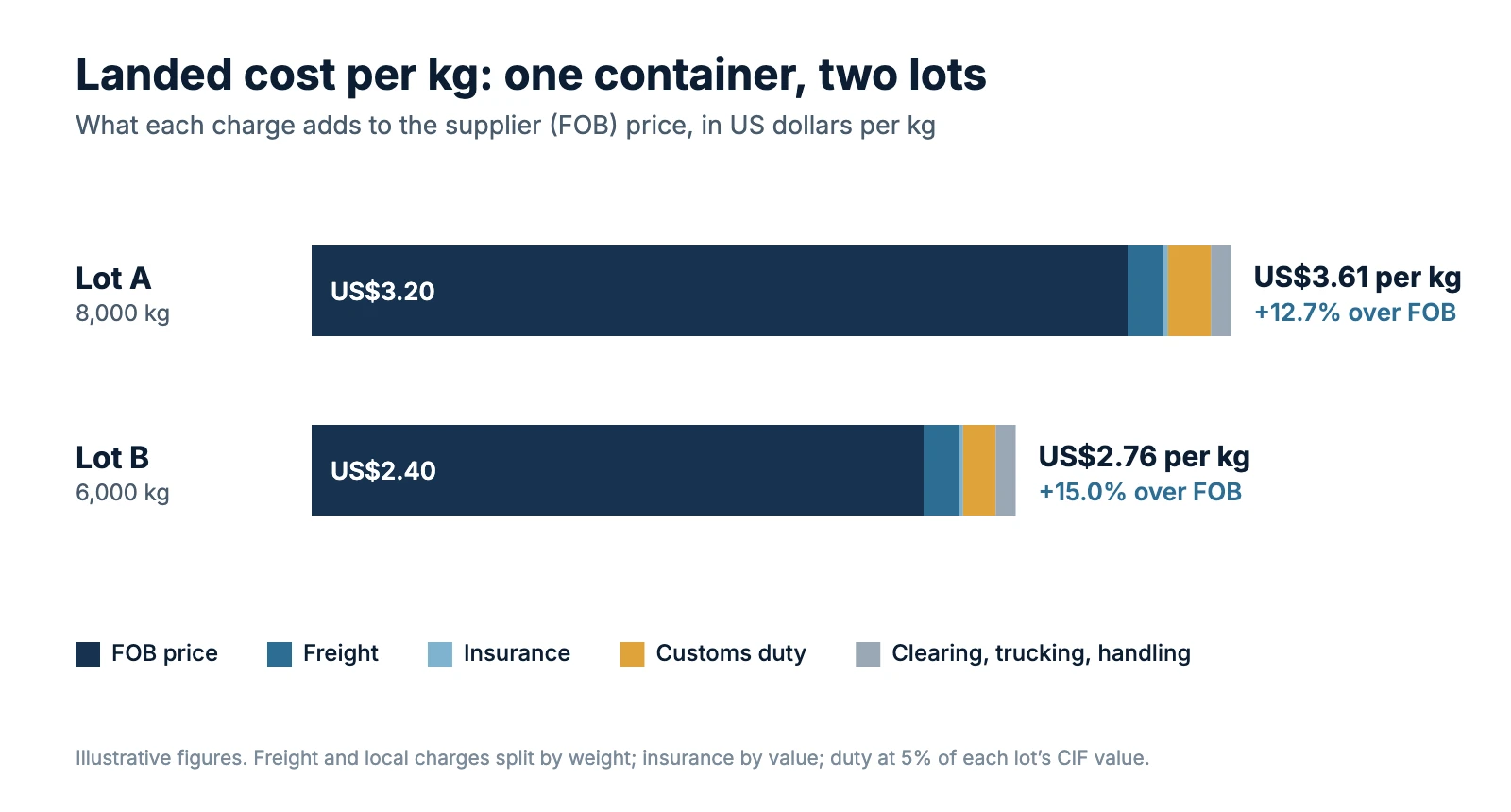
Landed cost per kg | US$3.61 | US$2.76 |
Increase over FOB price | 12.7% | 15.0% |
The whole container lands at US$45,410 against a supplier invoice of US$40,000. Import VAT of about US$2,215.50 is also paid at the border, but it stays out of stock cost when it is recoverable.
Why does the split method change your margin?
Charges split by weight fall harder on cheaper goods, because a kilogram of a low-value lot carries the same freight as a kilogram of a high-value lot. In the example, Lot B’s cost rose 15.0% while Lot A’s rose 12.7%.
If every charge had been split by value instead, Lot B would show a landed cost of US$2.72 per kg rather than US$2.76. That gap looks small, but on a lot sold at thin commodity margins it can be the difference between pricing at a profit and pricing at a loss.
A sensible rule is to split each charge by what drives it: freight and handling by weight or volume, insurance and duty by value, and per-shipment fees by weight or equally. Write the rule down and apply it on every shipment, so margins stay comparable from month to month.
See landed cost calculated on your own shipment. Book a demo
How does Odoo calculate landed cost?
Odoo adds landed costs to stock through the Landed Costs feature in Inventory, which is part of the free Odoo Community edition as well as Enterprise. Each landed cost line has a split method: Equal, By Quantity, By Current Cost, By Weight or By Volume (Odoo documentation). The basic setup is:
Turn the feature on. In Inventory, go to Configuration, then Settings, and enable Landed Costs in the Valuation section.
Create a product for each charge. Freight, insurance and clearing are each a service product marked “Is a Landed Cost”, with a default split method.
Set the costing method. The goods you import must sit in a product category that uses FIFO or average cost (AVCO).
Record weights and volumes. Weight and volume splits need these on every product.
Apply the charges to the receipt. From the vendor bill for each charge, create the landed cost, select the validated receipt, compute, check the valuation adjustments and validate.
Once validated, the extra cost moves into stock value and flows into cost of goods sold when the goods are sold. Duty is a percentage of CIF value, so check whether your setup computes it or records the amount from the customs bill.
For trading companies, Strata sets this up as part of the purchase-to-stock flow, alongside container and clearing records in our logistics platform. If you buy in one currency and sell in another, our blog on multi-currency ERP for traders covers the exchange rate side of the same shipment.
What are the common landed cost mistakes?
Booking freight and duty straight to expenses. This overstates gross margin on the sale and understates stock value.
Adding charges after part of the stock is sold. The share that belongs to goods already sold should go to cost of sales for that period.
Using one split method for every charge. Weight and value tell different stories, as the example shows.
Leaving product weights blank. Weight-based splits cannot work without them.
Mixing currencies without a fixed rate date. The supplier invoice and the freight bill often arrive in different currencies on different days.
Frequently asked questions
Is import VAT part of landed cost?
Usually not, if your business is VAT-registered and can recover it. Taxes you cannot recover are part of the cost of the goods.
Should demurrage or detention be included?
If the charge arises from bringing that shipment into stock, many businesses include it. If it comes from a separate delay or dispute, some expense it instead. Agree a policy with your accountant and apply it consistently.
Can I add landed cost after the bill arrives late?
Yes, but the sooner the better. If some of the stock has already been sold, part of the late cost belongs in cost of sales.
If you’d like to see one of your own containers costed this way, book a demo or send us a message on WhatsApp.
General information, not tax or accounting advice. Example figures are illustrative.
Written by Ayesha, Head of Design at Strata Software Solutions LLP.
Cover image: onlyyouqj on Magnific.